
–Is post is a part of a series of post about school work Ive had to do, and I’ve decided to post. Theses may be book reviews, Biographs, research paper, etc–
Context-
This is a research paper I had for Seminary, I am NOT a scholar nor will I claim to be. This is just some study paper for people to read and maybe learn from. Also I can, and WILL be wrong about a lot of things, so if you have doubt about anything I say just double check my work
Interdiction
In the field of textual criticism and Christian apologetics there is a problem called the Johannine Comma. The Johannine Comma is the is a longer version of 1 John 5: 7-8 that came into circulation around the 16th century. Along with the Johannie comma there are manuscript issues with verse 6 as well. With the Johannine Comma (JC) and the issue with verse 6, which will be coined: JSI (John Six Issue), there has been a lot of criticism with the textual reliability of the book of 1 John and the Bible because of the issues. So, this paper will be discussing the Manuscripts and tradition of 1 John, the criticism behind JC, and how to reconcile with JC and JSI. This paper with argue that JC and JSI are not an issue for the reliably of the Bible but shows that we can trust the Bible even more.
Reading
Reading the different verses of 1 John 5:6-7 is important to understand the argument of the paper. Starting with the shorter reading of the text, then move on to the Johannine Comma.
“For there are three that testify: the Spirit, the water and the blood; and the three are in agreement.” (NIV).
And now the Johannine Comma, “For there are three that bear record in heaven, the Father, the Word, and the Holy Ghost: and these three are one. And there are three that bear witness in earth, the spirit, and the water, and the blood: and these three agree in one.” (KJV).
Manuscripts and Tradition of 1 John
Textual criticism is where people look at manuscripts and compare them to each other to see the differences between them. Along with textual criticism the paper will also use early church fathers that quote scripture. With these two ways of testing manuscripts and scripture the paper will be able to test 1 John.
Manuscripts of 1 John
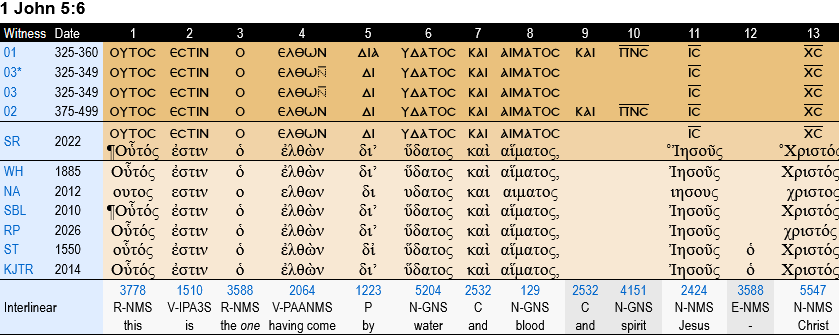
Looking at the 11 manuscripts of 1 John 5:6 that we have, we can see that Codex Sinaiticus1 and Codex Alexandrines2 both have extra words in them that differ from the other 9 manuscripts.3 Codex Sinaiticus and Codex Alexandrines both have “And Spirted” added to them. Although no Bible today has these words added to them it’s still strange that two of are major manuscripts of the Christian world have them in there.4
Now looking at JC in verses 7-8 we see that Stephanus Textus Receptus5 and King James Textus Receptus6 both have the JC.7 And the other 9 manuscripts that we have of 1 John are missing it.
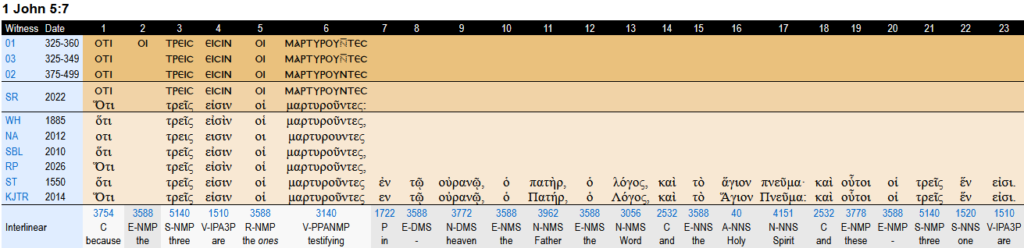
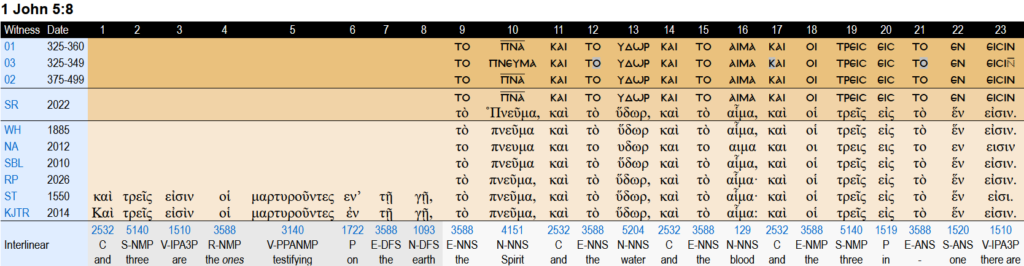
Images from, “The Development of the Canon of the New Testament,” Glenn Davis, 1997-2010, http://ntcanon.org/Polycarp.shtml#John_I
Early Church Fathers
Early Church fathers are one of the best ways to know how old a book of the Bible is. That’s also how we know how we know that the long ending of mark is trust-able. But in this case, Church fathers don’t really help us understand JC or JSI. One of the only church fathers that we have quoting 1 John is Polycarp.8 And Polycarp only quotes 1 John 4:3.9 Besides that we don’t really have anyone else quoting 1 John. Even though Polycarp is one of the only Church fathers he still helps us get a understanding of the dating of 1 John.
The Criticism Behind JC
Critical scholars like Bart D. Ehrman say that JC was added to Textus Receptus (TR)10 by Erasmus because of pressure from other Christians, and so therefore we can not trust that the Bible was not changed for the sake of Christology.11 Although that is the case that Erasmus did add JC to TR because of pressure from other people. It does not necessarily follow that we can’t trust the Bible. For two main reasons this is the case.
One: Erasmus is known for making controversial work and putting himself be hide a screen to protect himself. Erasmus is well known for making Praise of the Folly, which is the sexiest radical book that hides Theological truths that would have gotten him killed at the time. With Erasmus writing this book he was no stranger to getting pressure from people.
I would follow to say that Erasmus added JC to protect himself from all the Catholics that were trying to kill him, so he could live and write more work.12 And Even If Erasmus added JC to TR, he made a way for people to find out that JC was added.
Erasmus was very smart man, and the first man to make a full Greek New Testament. He was also one of the first proto-reformers and had options that would get him killed. Erasmus could keep his work alive and pass it to the next generation if he concedes to add JC to TR. So, even if Erasmus added JC to TR, he did it for his mission and kept a way to show us the true Bible, so therefore we can still trust the Bible.
Two: Even If Bart is correct on his premises, it doesn’t truly follow that he is correct. Even if some manuscripts of the Bible have been tampered with, that does not mean that the Bible today has been changed. Knowing that Erasmus added JC to TR is a great example of that. We only know the errors in the manuscripts because we have the truest form of the Bible now.
Here is a good analogy: People who test money to be fake, they study the real bill. And understanding the real bill they can know the counterfeit. It’s the same idea as the manuscripts. We have so many manuscripts that say one thing, and we use those to make our Bible today. And knowing that most of the manuscripts match we can know that these smaller manuscripts that don’t match are wrong. Therefore, we have the truest version of the Bible today.
How to Reconcile with JC and JSI
There is a lot of mystery behind JC and JSI, mostly because of relying on history. And it’s hard to defend the text when we have Muslims and Atheist attacking it. But using logic and history we can defend 1 John. For defending Johannie comma, the paper will be using History, and to defend the John Six Issue the paper will be using logic.
Defending the Johannie Comma
History is the best way to understand JC so let’s look at the history of it. Erasmus was making the first full Greek New Testament, Textus Receptus. And while Erasmus was looking for older Greek manuscripts to make TR, he found out that none of the had JC and so he had decided not to add JC to TR. But he got a lot of back lash from the people around him, because 1 John 5:6-7 was a very popular Trinty proof text. And the Christians around him where out raged and called him an Arian (a 1-3 century heretic).13 [This next part is not recorded in any records but came to be understood by logic. See the section on the Criticism Behind JC] So, to protect himself, Erasmus added JC to TR to protect himself from being killed and protect his work from being thrown away. Even though He had to add to Gods words, he made a way for us to find out it was not supposed to be there.
John Six Issue
There are not many people who talk about JSI, but some theories a few things about it, A: scribes added it, or B: Scribes removed it. That’s basically all we know about JSI. So, there is not much to defend and it’s just better to just mark it off as a scribal error.
Conclusion
This paper discussed the history and the scholarship behind Johannie Comma and the newly coined, John 6 issue. This paper defined the Christian Bible by showing the Johannie Comma is not an issue, but actually shows that the Bible is even more trustworthy, and can last the test of time. While showing the John 6 issue, is not a issue but just scribal errors.
End notes
- Codex Sinaiticus dates around 325 AD ↩︎
- Codex Alexandrines dates around 375 AD ↩︎
- “Center for New Testament Restoration,” Alan Bunning, accessed November 3, 2026, https://greekcntr.org/collation/index.html?&v=62005006 ↩︎
- “Bible Hub,” Online Parallel Bible Project, accessed November 3, 2026, https://biblehub.com/1_john/5-6.htm ↩︎
- Stephanus Textus Receptus dates around 1550 ↩︎
- King James Textus Receptus dates around 1598 ↩︎
- Alan, “Center.” ↩︎
- Polycarp lived around 69-155AD ↩︎
- “The Development of the Canon of the New Testament,” Glenn Davis, 1997-2010, http://ntcanon.org/Polycarp.shtml#John_I ↩︎
- Textus Receptus was dated around 1516 ↩︎
- Ehrman, Bart, _Misquoting Jesus: The Story Behind Who Changed the Bible and Why (New York: HarperCollins Publishers, 2005, 79-83 ↩︎
- Bart, _Misquoting, 82 ↩︎
- Bart, _Misquoting, 81-3 ↩︎


